
Nuclear medicine
Nuclear technologies play a vital role in modern healthcare, supporting the diagnosis, treatment and understanding of disease.
Our researchers are advancing knowledge of how radiation interacts with biological systems, helping improve the safety and effectiveness of medical applications.
Research areas include:
- radiation biology;
- radiation effects in cells and tissues;
- DNA damage and repair;
- modelling and simulation of radiation effects;
- radiotherapy and cancer treatment;
- medical applications of nuclear technologies.
Research at Manchester is focused on understanding the physical, chemical and biological processes that occur when radiation interacts with cells and tissues. This knowledge underpins the development of more effective cancer treatments and helps optimise the use of radiation in healthcare.
Using the Dalton Cumbrian Facility, researchers can investigate the effects of different types of radiation, including photons, protons and heavier ions, on biological samples. These studies provide valuable insight into DNA damage, cellular responses and the relative effectiveness of different treatment approaches.
Researchers also use advanced modelling and simulation techniques to better understand radiation effects across multiple scales, from the initial damage caused to DNA through to impacts at the tissue and whole-patient level. By combining experimental and computational approaches, Manchester is helping build a deeper understanding of radiation and its role in modern medicine.
Through collaboration with healthcare providers, research organisations and industry partners, this work is supporting the development of safer, more effective treatments and advancing the application of nuclear technologies in healthcare.
Related resources
-

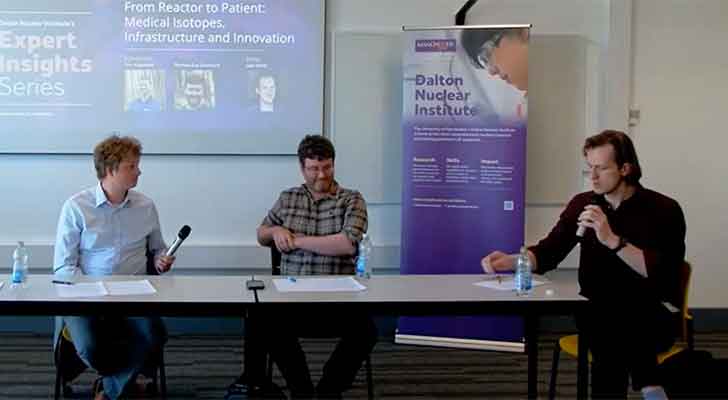
Seminar: From Reactor to Patient Medical Isotopes, Infrastructure and Innovation
Watch the medical isotopes seminar on YouTube
-

Seminar: Radiopharmaceutical Production and Research for Cancer Treatment
Watch the radiopharmaceuticals seminar on YouTube
Stay connected
Receive updates from the Dalton Nuclear Institute, including the latest research, policy papers, events and opportunities to engage with our nuclear research community.