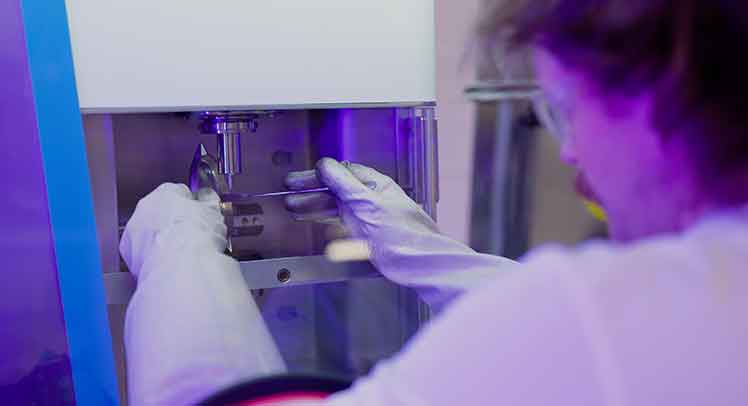

Accident-Tolerant Fuel
Our researchers are developing nuclear fuel solutions with increased tolerance to high temperatures.
Impact at a glance
Challenge
Improve the resilience of nuclear fuel during severe accident conditions.
Solution
Develop accident-tolerant fuel and cladding materials capable of withstanding higher temperatures.
Potential impact
Enhanced reactor safety, reduced accident consequences and lower costs for future nuclear power plants.
Background
In water-cooled nuclear reactors, the most critical component in fuel assemblies is the cladding, which encapsulates the fuel, retains any fission products produced during the nuclear reaction and transfers heat generated by the fuel to the surrounding water.
Currently, a zirconium alloy cladding is used but this is prone to failure during accident conditions, as highlighted by the Fukushima Daiichi incident in 2011.
The University is the academic host for the UK's Nuclear Fuel Centre of Excellence, providing extensive capabilities for the manufacture, characterisation and testing of uranium and thorium fuels.
Challenge
Following the earthquake and tsunami at Fukushima Daiichi, the reactors shut down automatically but decay heat continued to be generated within the fuel.
Under these conditions, zirconium alloys can oxidise rapidly at elevated temperatures, potentially leading to:
- degradation of the fuel cladding;
- damage to fuel assemblies;
- hydrogen generation through corrosion;
- increased risk of explosions during accident scenarios.
Solution
Facilities supporting this research
Dalton Cumbrian Facility
Ion beam and gamma irradiation testing of fuel materials.
Our researchers are developing accident-tolerant fuel solutions which would provide more grace time (the time before active cooling is required) or, ideally, be immune to the kind of sustained high temperatures created by decay heat and insufficient cooling.
The University of Manchester is the academic host for the UK’s Nuclear Fuel Centre of Excellence, providing extensive capabilities for the manufacture, characterisation and testing of uranium and thorium fuels.
Fuels can be subjected to ion beam and gamma irradiation at our Dalton Cumbrian Facility. Potential solutions include composite silicon carbide cladding and advanced fuel materials, such as uranium silicide.
Benefits
Development of accident-tolerant fuels could:
- reduce the consequences of severe accidents;
- improve passive reactor safety;
- increase resilience during loss-of-coolant events;
- reduce reliance on backup safety systems;
- lower future nuclear build costs.