
Radiation Effects in Waste Packages
We’re helping to develop a better understanding of how radioactive waste behaves over thousands of years.
Impact at a glance
Challenge
Understand how radioactive waste materials respond to radiation over thousands of years in geological disposal environments.
Solution
Use specialist irradiation facilities and waste simulants to investigate how different waste forms behave under long-term radiation exposure.
Potential impact
Provide the evidence needed to support the safe storage, management and disposal of radioactive waste over geological timescales.
Background
Current UK policy is for historic nuclear waste, accumulated from old reactors and fuel reprocessing operations, to be disposed of in a geological facility.
This requires the behaviour of the waste to be known over a timescale of thousands of years. The self-irradiation of the waste will be an important factor in determining its behaviour.
There are several different types of waste generated from historic nuclear industry operations which must be treated to make them suitable for interim storage and final disposal.
Our specialist expertise and experimental capability complement the knowledge and experience of our industry partners. This synergy allows us to develop an in-depth understanding of radiation effects directly relevant to current challenges for waste management.
Dr Laura Leay / The University of Manchester
Challenge
High level waste from the reprocessing of spent fuel is incorporated into glass while waste such as redundant plant components are encapsulated in a cement based grout.
Each final waste form may respond in different ways to radiation; the glass may swell or crack and the grout may change in microstructure and potentially generate hydrogen and oxygen gas as the radiation causes pore water to break down.
The long timescales associated with geological disposal must also be considered and so the applicability of accelerated irradiation studies, where the lifetime radiation dose is applied on a much shorter timescale, is key.
Solution
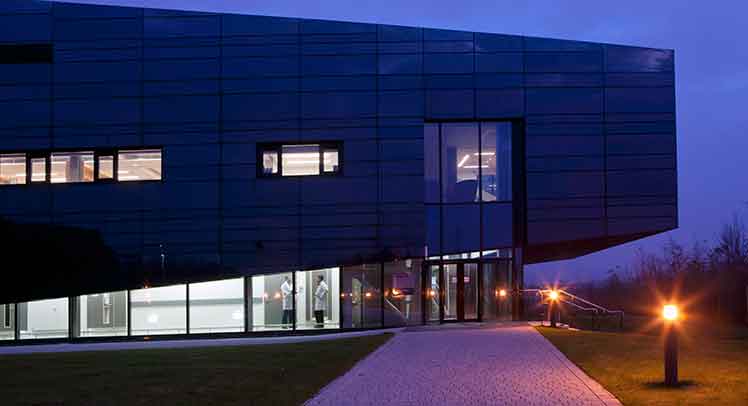
A research team at The University of Manchester's Dalton Cumbrian Facility is working closely with industry to produce non-radioactive simulants of these wastes and then, using the unique irradiation equipment at the facility, is examining the effects of multiple radiation fields.
A regime that probes the effect of both total radiation dose and dose rate is used in order to determine whether accelerated irradiation trials are indeed representative of the long timescales applicable to disposal.
Benefits
The Dalton Cumbrian Facility provides various methods of irradiation.
The particle accelerator can provide carefully controlled amounts of alpha, proton and heavy ions and the gamma irradiator compliments this capability.
Sample preparation and extensive analysis can also be carried out in-house.
Links to further capability on The University of Manchester's main campus as well as the Henry Moseley X-ray imaging facility on beam line I-18 at the Diamond light source in Harwell provide further in-depth analysis.